
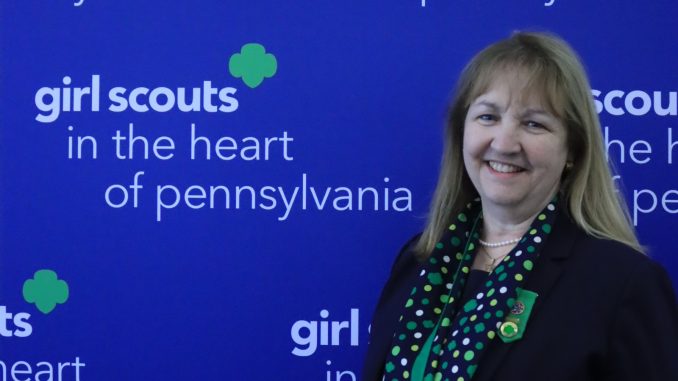
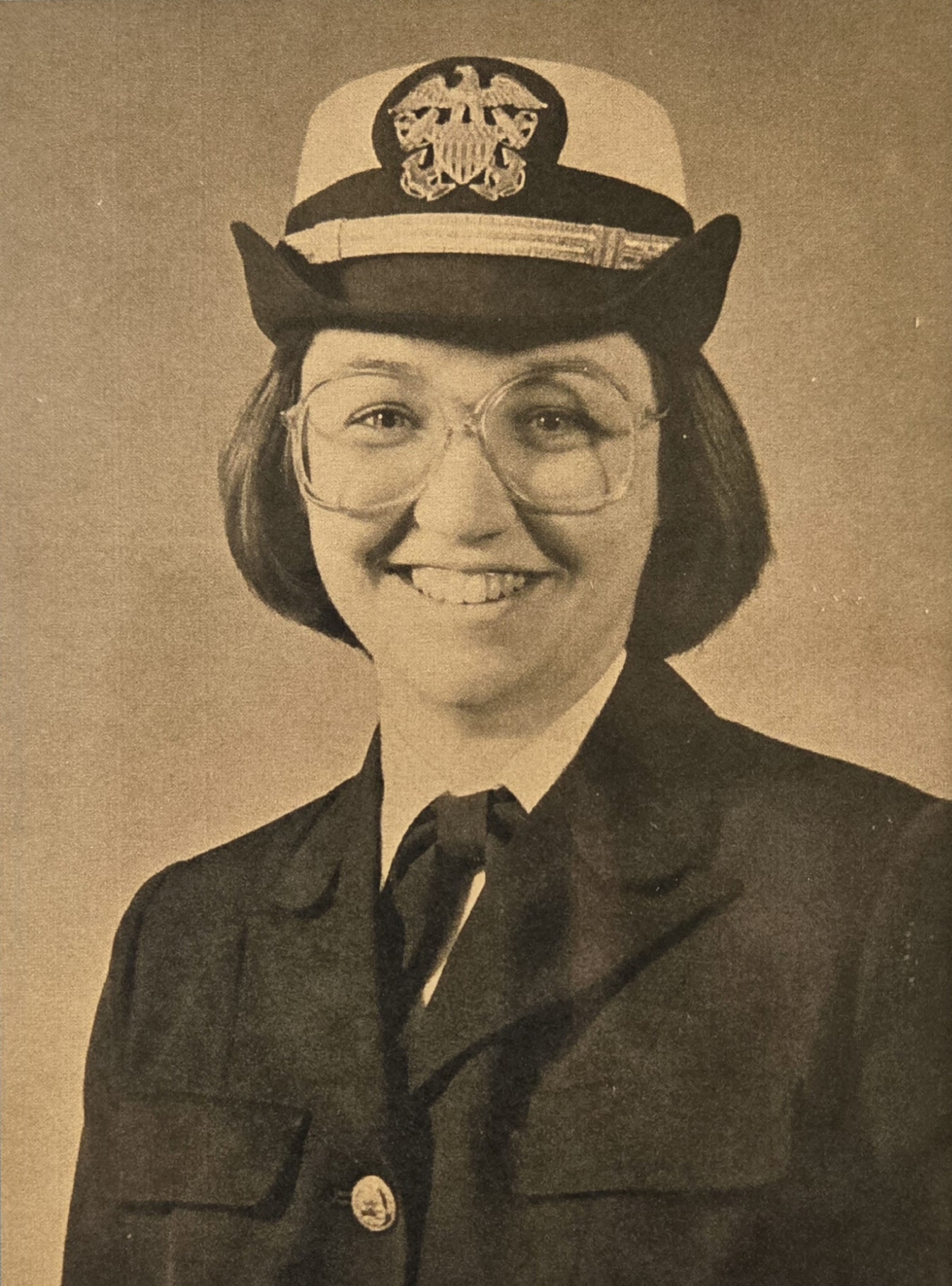
 Janet Donovan, president and CEO of Girl Scouts in the Heart of Pennsylvania, has enjoyed a remarkable career that bridges military excellence and transformative leadership. A retired U.S. Navy rear admiral who was an attorney in the Judge Advocate General’s Corps, Donovan served her country with distinction for 30 years while breaking down gender barriers along the way.
Donovan’s military awards include the Defense Meritorious Service Medal (oak leaf cluster), Meritorious Service Medal (two gold stars), Navy and Marine Corps Commendation Medal (gold star), and Navy and Marine Corps Achievement Medal (two gold stars). In her personal life, Donovan is wife to husband Dan, and mother to three adult daughters, Kate, Jackie and Bridget.
Her success exemplifies her skills in strategic foresight, talent cultivation and collaboration and has positioned her to lead in an ever-evolving world. She will be a featured speaker at the Embracing Ambition Conference, taking place on March 26 at the Harrisburg Hilton. The symposium will spotlight the book “Embracing Ambition: Empowering Women to Step Out, Be Seen, & Lead” written by Jenny Mitchell. The book features first-person accounts by Donovan and 11 other trailblazing women leaders who have navigated challenges, shattered barriers and forged new paths in their industries. These women will share insights on overcoming perception barriers, integrating personal identity with professional success and leading with vision. Visit https://embracingambition.sched.com/about for more information.
 Donovan will also attend the Girl Scouts’ Women of Distinction Gala that same night in the same venue, where five local women will be honored for their impact on girls and young women. Visit www.gshpa.org for additional details.
As someone who has witnessed firsthand the profound impact of Girl Scouts on young women, Donovan is a passionate advocate for the organization’s mission. Since 1991, she has overseen a 30-county region in Pennsylvania that serves more than 11,000 girls in 970 troops. She firmly believes in the transformative power of Girl Scouting to shape the next generation of confident, capable leaders.
She recently sat down with Eric Ebeling, editorial director of Harrisburg Magazine, in her Girl Scout headquarters on Trindle Road in Camp Hall to discuss her organization, her impressive career and the keys to strong leadership.
Eric Ebeling: Were you a Girl Scout?
Janet Donovan: I was a Girl Scout. I was shy as the wallpaper as a little girl. How do you just figure going door to door, knocking on somebody’s door? Then, I’m going to ask them whether or not they’re willing to buy a box of cookies, and they’re either going to order a box, or they’re going to say no. How do you do that with confidence? That’s a big piece of what our programming does, and we’re hoping that this is growing the next generation of small business owners and large business owners. So, we know that participation in the cookie program and in all of Girl Scouting makes it more likely that girls will be leaders when they become women are in the community.
EE: You mentioned you were shy as a child, shy to ask questions. How do you go from being so shy to launching a career as an attorney and going into the military? Can you walk me through how that happened?
JD: That’s a big question. I certainly love my career in the Navy, you know, and yes, I was shy as a little girl. The Girl Scouts definitely helped me, for sure. I think about the little girls we see. We had one that was in one of our programs last year who came with Dad and her big sister. For the entire program, which went over many weeks, she just kind of clung to Dad’s leg. She’s watching, clinging to Dad’s leg. By the end, the finale was a big bonfire, and they’d been learning Girl Scout songs. So, the staff member who was there had asked this little girl, “Is there anybody out here? Raise your hand? Does anybody want to come up and lead the singalong?” And here comes this girl, the one who has been clinging to her dad’s leg for the whole time, and says, “I can do that.” And she went up and loved the singalong.
I think part of it is confidence. I believe confidence comes from competence. The more competent you are, the more confident you get. For her, and probably for me too, it’s like going door to door, and then you get to this point: “I can do that, I think I can do that,” and then you do it. It’s incremental, right? Of course, the military does a phenomenal job of training. It will put you into a situation, and sometimes it’s sink or swim, but most of the time, there’s a training curriculum that comes along with that. We do the same thing for our girls. We do that for our leaders through the training curriculum.
EE: When you joined the Navy, were you looking at more jurisprudence aspect of your career or the military or the military on, or were they equal in your mind?
JD: It’s kind of interesting. When I graduated from law school (Case Western University), if you wanted to go out into the civilian sector and do litigation, and you went to a law firm, you would basically be sitting second or third chair and kind of carrying somebody’s briefcase for five to seven years. You’re not going to run your own caseload. One of the recruiting messages that the Navy had was “come in the Navy. You’re going to have your own caseload, which I did. Within nine months, I was the senior prosecutor. I had my own caseload and then some, and that’s what I wanted. It’s that idea of going out and actually having your own responsibility on the lawyer side of it. The military could give me that. I never intended to have a career in the Navy. I thought it would go do my three years, and then they said, “Well, how about this job?” And I said, “That sounds kind of cool,” and then you go to the next place and they say, “I think you might want to go on a ship.”
EE: Can you explain how someone becomes a rear admiral?
JD: The Navy has a selection board to select people at every rank. At that time, they looked at all of the captains who had three years’ time and grade. When I went up, there were 113 captains competing for admiral. The board looks at your record, and they can look at a package that you submit as a candidate, which could have letters of recommendation and things like that. The board votes, and it is all anonymous. They look at your record. Here’s the responsibilities that this person had, here’s the assignments that they had. Then they look at, basically, your military report card, because at each one of your jobs, you’re getting an evaluation. The Navy’s evaluation is on a scale of one to five. So, how many fives do you have? They look at your performance review, and they look at your whole career. At the time, they were selecting one person every four years to serve in my position. I was very honored to be selected. It was a surprise to me. I will say that others may have seen it coming, but I did not.
EE: Switching gears: Can we talk about cookies? They might be the most recognizable thing about Girl Scouts for the general public.
JD: Through the cookie program girls continue to learn business. It’s an entrepreneurship program, and we really know that’s their first exposure. Girls, when they’re really young – the research tells us – they want to have their own businesses. Somewhere around the early teenage years, they start to believe that they’re not going to be supported by society and having their own business. We know from the research because Girl Scouts has its own research institute in Manhattan. We’re the only youth development organization in the United States that does. We know from the research that the only thing that helps girls move through that entrepreneurial space is continued exposure to entrepreneurship. The more comfortable they get, the more secure they get in the thought that they can own their own business someday.
We are in the thick of cookie season right now, so girls are selling, and this year we have a fabulous new way to order cookies online. People can go to our website and pull up a database (that allows customers to order directly from their local troop). There is also a random troop generator in there. People will say, “I don’t know how to find cookies,” because the Girl Scout who used to be in her neighborhood or her daughter or niece, they have grown up, and they don’t sell anymore. This is a great way for girls to learn about passive income. You’re sleeping and you’re still earning money, right? We tell girls to sign up your troop. Your troop will then go into the random generator. When someone who doesn’t know you wants cookies, they can come in and pick your troop, and you can wake up the next morning and find, “Wow. I sold 10 boxes of cookies last night.” When you think about business skills, that’s the future of business – with everything being digital. I imagine you have an Amazon app right on your phone, right?
EE: I sure do. When girls are running their campaigns for cookies, they’re obligated to keep track of money in, money out, delivering goods, all of it?
JD: Yes, there’s a financial literacy component to it. There’s a marketing component to it, and now there’s a digital marketing component to it. We have girls now who have their own little websites. They can be up on Facebook with family and friends. It’s amazing how innovative they are. … There are 50 million women in America who were Girl Scouts, and so they remember their own Girl Scouting experience, and many of them will relate their current business experience back to when they were Girl Scouts. I am who I am today because I was a Girl Scout, and I’m very proud of that, and I know that Girl Scouts has the potential to impact the next generation.
EE: Can you give me an example of that?
JD: One of the programs that we’re very proud of is our Academic Edge Program. It provides a Girl Scout experience that’s led by staff for girls who live in poverty. We go into school districts that are 51 percent or more free and reduced lunch, and we provide staff for them so that they can have a Girl Scout experience, the same as if they were able to have a troop-type experience. We will come to them. We’re in specific schools. We’re in Lancaster City or in York city. We’re in Scranton. We’re in Harrisburg. We’re in Williamsport, South Williamsport – so probably about 150 girls right now in that program and growing.
It’s just a great opportunity for girls who live in poverty, because we know that the two barriers for girls who want to be Girl Scouts are money and transportation, right? They don’t have somebody who’s going to be able to drive them to a meeting spot, and they don’t have the money to be able to pay for dues. Through the generosity of donors, we’re able to provide that, and then staff provides the Girl Scouting experience. This year, many of our academic edge girls, for the first time, are going to be actually selling Girl Scout cookies, which is a super exciting thing for them. It’s their first exposure to real business, and they’re able to earn money that goes toward girls getting experiences for their troop, if you will. The troop, in this instance, would be those girls who are at the school with them. In Scranton, we have a waiting list to get into the program. We’re super excited about that.
EE: How did you end up as the CEO here?JD: I didn’t think that I would be coming to Girl Scouts. I thought I would be moving to the corporate boardroom, but as I was doing one of the millions of women-on-boards programs that are cottage industry out there right now, one of my colleagues at the inaugural program for Yale Women on Boards said to me, “I don’t think you’re going to the boardroom yet. I think I found a job for you,” and she showed me this job. She said she had heard my personal statement, which is, “I want to do things that empower young women to make choices that value their worth.” She thought the Girl Scouts would be a great place to do that. So, I threw my hat in the ring – and here I am.

